
Automate Cheque Processing with AI Software
Published: 16/07/2026
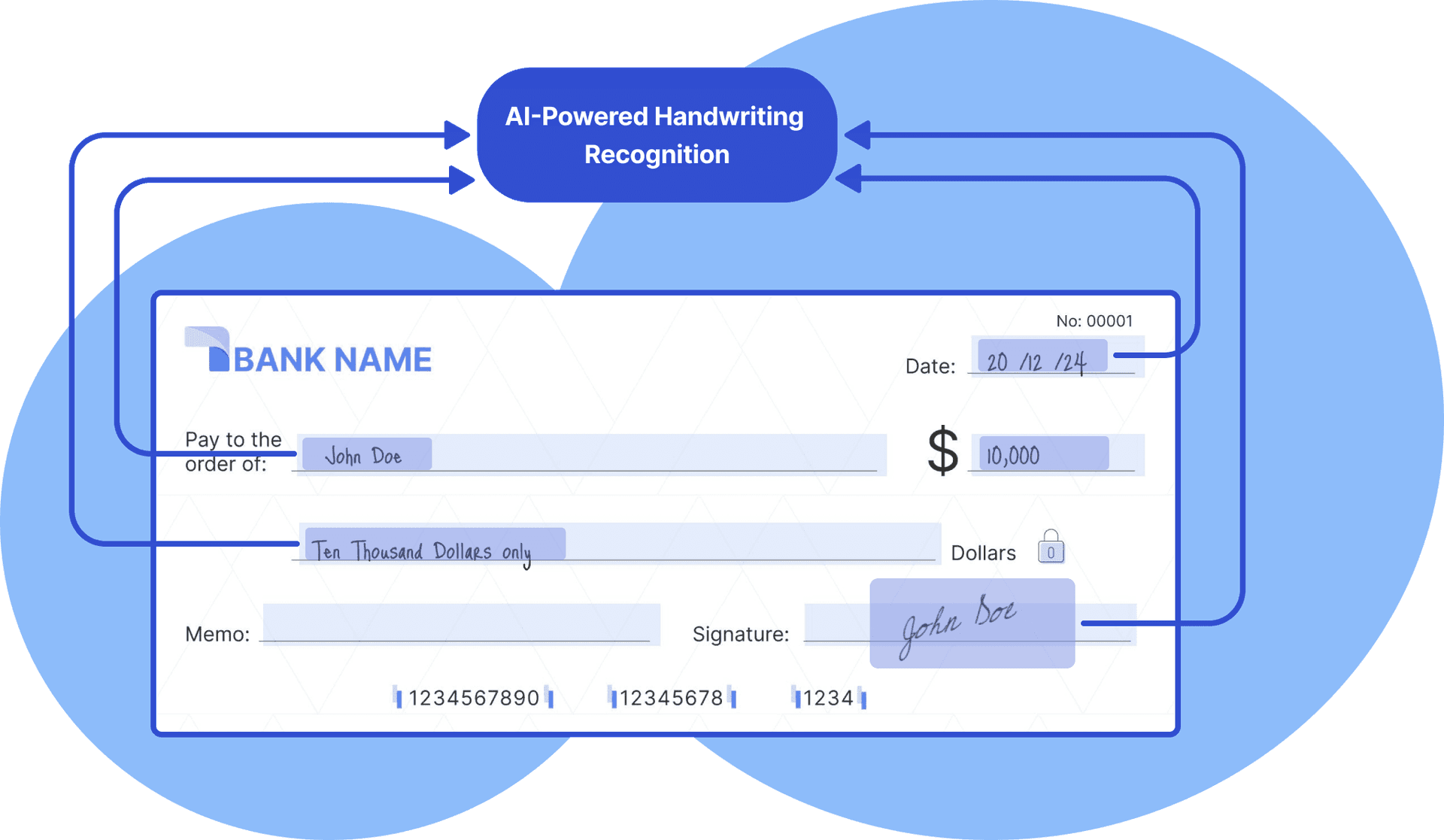
Manual cheque handling creates a predictable set of costs: staff hours spent on data entry, settlement delays from paper transport, discrepancies between the written amount and the numeric amount, and fraud that slips through when not every cheque is individually reviewed. Each of these scales with volume, and none is solved by hiring more people.
Automated cheque processing addresses all of them through one pipeline. The system captures the cheque image, extracts every field — including handwritten payee names and amounts in words — validates the data against business rules, and submits to the clearing network, the core banking API, or the receivables ledger without manual intervention. The same engine runs whether a customer feeds a single cheque into a kiosk or a back-office team scans a tray of a thousand.
How the pipeline works
Image capture comes first. At self-service kiosks, the CDM-embedded cheque scanner captures front and back images. Desktop scanners at teller stations and high-throughput scanners at back-office centres use the same input format. Where the hardware supports it, UV images are captured alongside visible-light images, revealing security features and chemical alterations invisible to the naked eye.
The extraction stage runs OCR on printed fields and ICR on handwritten fields. OCR reads machine print; ICR reads handwriting. Payee name, date, written amount in words, and numeric amount in figures are each extracted independently and returned with confidence scores. The MICR line — the magnetic characters along the bottom of the cheque, encoded as E-13B or CMC-7 — is read and validated against the serial number printed in the cheque body.
Validation cross-checks the extracted fields. The amount in words must match the amount in figures. The date must be valid, not stale, and not post-dated beyond the bank's policy window. The MICR serial must match the printed cheque serial. Signature regions are extracted and scored against the reference signature on file. Each check returns a pass-or-fail result.
On a clean result, the validated data posts straight through to the clearing network, the core banking API, or the corporate ledger — no manual step. On any failure, the cheque routes to a review queue or is returned to the customer, depending on policy.
One pipeline, three operators
The same processing path serves three very different operators. That is the point. Banks do not build or maintain separate systems for each capture point.
A self-service customer deposits a cheque at an unattended kiosk and the workflow runs end to end without a member of staff. A teller at a branch counter scans the cheque on a desktop unit, sees the extracted fields and any exceptions on screen, and confirms or corrects before posting. A back-office processing team feeds high volumes through faster scanners, working an exception queue rather than keying every cheque by hand. Extraction, validation, fraud checks, and posting are identical across all three; only the front end and the level of human oversight change.
That shared path matters for cost and consistency. A discrepancy is caught the same way whether it arrived at a kiosk at midnight or across a counter at noon. The audit trail reads the same regardless of who — or what — captured the cheque.
Built for high-volume corporate cheques
Corporate cheque flows are where manual processing hurts most. A business depositing supplier refunds, customer payments, or collections often presents cheques in batches. On the other side, a treasury or accounts-receivable team must key each one, match it to an invoice, and chase the mismatches. Volume turns a minor per-cheque cost into a daily backlog.
The pipeline absorbs that batch the way it absorbs a single deposit. Trays of cheques scanned at a back-office centre are extracted, validated, and reconciled as a set, with only genuine exceptions surfacing for a person to look at. For the corporate customer this is the difference between funds that clear days later and funds that clear same-day or next-day, with a structured record of every instrument for their own books.
An add-on to your core banking and ERP
Cheque data is only useful once it lands in the system that acts on it. The pipeline outputs structured, validated records — payee, amounts, MICR, dates, decision — that post directly into a core banking platform over its API, or into an enterprise resource planning system as a receivables entry.
For corporate finance teams, this is where the system earns its place as an add-on rather than a standalone tool. A cheque posted against an open invoice in an ERP such as Odoo, SAP, or Oracle reconciles the receivable automatically, instead of waiting for someone to match a bank statement line to a sales order by hand. ISO 20022 messaging — the structured standard most clearing systems and banks are moving to — means the same extracted data flows into core banking and clearing without custom formatting per network or per ERP. The cheque becomes a clean, machine-readable transaction the moment it is scanned, wherever it needs to go next.
Why this matters at scale
The operational difference is not marginal. A bank processing thousands of cheques per day across a branch network eliminates the data-entry backlog. It cuts settlement time from days to same-day or next-day. It catches discrepancies — written-versus-numeric amount mismatches, stale dates, duplicate serials — before they enter the clearing cycle. A corporate running its collections through the same pipeline gets reconciled books without a room full of people keying figures.
Deployment and data control
Data stays within the bank's infrastructure. The system deploys on-premise or in the bank's own cloud environment. Compliance with truncation regulations and local clearing rules is built into the validation layer.
Oversight Mode gives operations teams visibility into the full processing cycle: audit history per cheque, error tracking by type, compliance reporting. Teams see not just that a cheque was rejected but why — which validation rule failed, at which confidence threshold.
See how mobile capture, desktop scanners, self-service deposits, core banking, and ERP connections fit together in the cheque processing system for banks and corporates. See the full production pipeline — MICR validation, signature verification, fraud detection, and clearing integration — on the Cheque OCR & Fraud Detection use case. For how the extraction engine reaches 97%+ field accuracy on handwritten fields, read the breakdown of the cheque OCR pipeline. And for the corporate angle in depth, see Digital Cheque Clearance: A Better Way for Corporate Customers to Bank.
Try it yourself
Book a demo
See how Azimut SDK works in your self-service environment. We'll walk through your use case, hardware setup, and integration options.
Continue reading
Azimut’s Cheque Management System: Digitising Processes with ISO 20022
Digitise bank cheque processing with Azimut’s ISO 20022 compliant system.
The Next Telecom Kiosk Has a Face — and an Engine Behind It
How the Azimut SDK powers every function an avatar kiosk needs.
Pre-Stage Any Terminal from Mobile — No Code Required
Pre-stage any terminal from mobile or external system — no coding needed.